Consider the Balanced Equation Below. What Is the Mole Ratio of to Fe?
12.2: Mole Ratios
- Page ID
- 53790
Suppose that you want to add together some sections to your porch. Earlier you lot go to the hardware store to buy lumber, you need to make up one's mind the unit limerick (the textile between 2 large uprights). You count how many posts, how many boards, how many rails—then you make up one's mind how many sections you want to add together—before you calculate the amount of building cloth needed for your porch expansion.
Mole Ratios
Stoichiometry problems can be characterized past two things: (1) the information given in the problem, and (2) the information that is to be solved for, referred to equally the unknown. The given and the unknown may both be reactants, both exist products, or one may be a reactant while the other is a product. The amounts of the substances can exist expressed in moles. All the same, in a laboratory situation, information technology is mutual to determine the amount of a substance past finding its mass in grams. The corporeality of a gaseous substance may exist expressed by its book. In this concept, we will focus on the type of problem where both the given and the unknown quantities are expressed in moles.

Chemic equations limited the amounts of reactants and products in a reaction. The coefficients of a balanced equation tin correspond either the number of molecules or the number of moles of each substance. The production of ammonia \(\left( \ce{NH_3} \right)\) from nitrogen and hydrogen gases is an important industrial reaction called the Haber process, after High german chemist Fritz Haber.
\[\ce{N_2} \left( 1000 \correct) + 3 \ce{H_2} \left( k \right) \rightarrow ii \ce{NH_3} \left( g \right)\]
The balanced equation can be analyzed in several ways, every bit shown in the figure below.
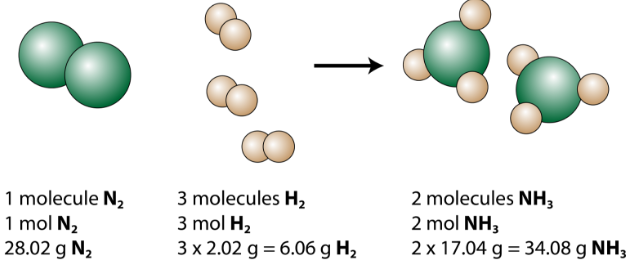
We see that 1 molecule of nitrogen reacts with iii molecules of hydrogen to form 2 molecules of ammonia. This is the smallest possible relative amount of the reactants and products. To consider larger relative amounts, each coefficient tin can exist multiplied by the same number. For instance, 10 molecules of nitrogen would react with thirty molecules of hydrogen to produce xx molecules of ammonia.
The nigh useful quantity for counting particles is the mole. And so if each coefficient is multiplied past a mole, the counterbalanced chemical equation tells u.s.a. that 1 mole of nitrogen reacts with 3 moles of hydrogen to produce two moles of ammonia. This is the conventional manner to translate whatever balanced chemic equation.
Finally, if each mole quantity is converted to grams by using the tooth mass, nosotros can meet that the constabulary of conservation of mass is followed. \(1 \: \ce{mol}\) of nitrogen has a mass of \(28.02 \: \text{k}\), while \(3 \: \text{mol}\) of hydrogen has a mass of \(6.06 \: \text{g}\), and \(2 \: \text{mol}\) of ammonia has a mass of \(34.08 \: \text{g}\).
\[28.02 \: \text{g} \: \ce{N_2} + 6.06 \: \text{thousand} \: \ce{H_2} \rightarrow 34.08 \: \text{thousand} \: \ce{NH_3}\]
Mass and the number of atoms must be conserved in any chemical reaction. The number of molecules is not necessarily conserved.
A mole ratio is a conversion factor that relates the amounts in moles of any two substances in a chemical reaction. The numbers in a conversion factor come from the coefficients of the balanced chemic equation. The following six mole ratios can be written for the ammonia forming reaction higher up.
\[\begin{array}{ccc} \dfrac{ane \: \text{mol} \: \ce{N_2}}{3 \: \text{mol} \: \ce{H_2}} & or & \dfrac{3 \: \text{mol} \: \ce{H_2}}{one \: \text{mol} \: \ce{N_2}} \\ \dfrac{1 \: \text{mol} \: \ce{N_2}}{2 \: \text{mol} \: \ce{NH_3}} & or & \dfrac{2 \: \text{mol} \: \ce{NH_3}}{1 \: \text{mol} \: \ce{N_2}} \\ \dfrac{iii \: \text{mol} \: \ce{H_2}}{2 \: \text{mol} \: \ce{NH_3}} & or & \dfrac{2 \: \text{mol} \: \ce{NH_3}}{3 \: \text{mol} \: \ce{H_2}} \end{array}\]
In a mole ratio trouble, the given substance, expressed in moles, is written start. The appropriate conversion factor is chosen in club to convert from moles of the given substance to moles of the unknown.
Case \(\PageIndex{1}\)
How many moles of ammonia are produced if 4.xx moles of hydrogen are reacted with an excess of nitrogen?
Solution
Step 1: List the known quantities and program the problem.
Known
Unknown
The conversion is from \(\text{mol} \: \ce{H_2}\) to \(\text{mol} \: \ce{NH_3}\). The trouble states that there is an excess of nitrogen, so we practise not need to exist concerned with any mole ratio involving \(\ce{N_2}\). Choose the conversion gene that has the \(\ce{NH_3}\) in the numerator and the \(\ce{H_2}\) in the denominator.
Step 2: Solve.
\[4.20 \: \text{mol} \: \ce{H_2} \times \dfrac{2 \: \text{mol} \: \ce{NH_3}}{iii \: \text{mol} \: \ce{H_2}} = 2.80 \: \text{mol} \: \ce{NH_3}\]
The reaction of \(four.20 \: \text{mol}\) of hydrogen with excess nitrogen produces \(two.80 \: \text{mol}\) of ammonia.
Step 3: Call back about your result.
The result corresponds to the three:two ratio of hydrogen to ammonia from the counterbalanced equation.
Summary
- Mole ratios allow comparing of the amounts of any two materials in a counterbalanced equation.
- Calculations tin can be fabricated to predict how much product can be obtained from a given number of moles of reactant.
Source: https://chem.libretexts.org/Bookshelves/Introductory_Chemistry/Book%3A_Introductory_Chemistry_(CK-12)/12%3A_Stoichiometry/12.02%3A_Mole_Ratios
0 Response to "Consider the Balanced Equation Below. What Is the Mole Ratio of to Fe?"
Post a Comment